Time & Attendance

Fingerprint Time Clocks: Secure, Fast, Impossible to Cheat

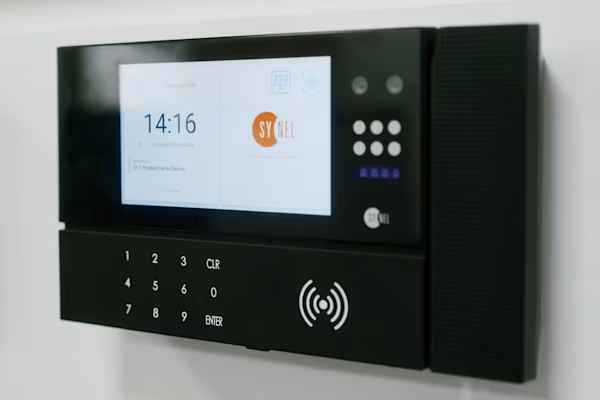
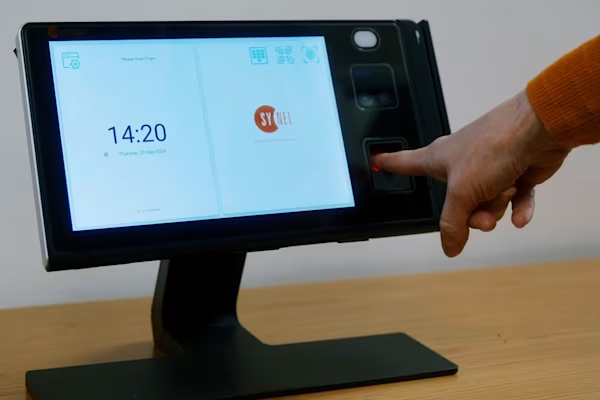
Fingerprint time clocks from Synel are designed to remove doubt from attendance. Each clock event confirms the person, not the credential, capturing time accurately without slowing people down. Templates are stored securely as encrypted data, not images, supporting real-world GDPR requirements.

The reality today

Buddy punching costs UK businesses millions annually. One employee clocks in for another who's running late (or not coming in at all). Cards get lost, shared, or forgotten. PINs get passed around. Payroll ends up paying for hours not worked, and you have no way to prove otherwise.

The Solution

Fingerprint time clocks tie attendance directly to the individual. Employees must be physically present to clock in, events are recorded instantly, and data syncs automatically across devices, removing ambiguity from time records without adding process or friction.

Eliminate Time Theft

Fingerprints can't be shared or faked. Every clock event is tied to the actual employee—no more paying for hours not worked.

Enterprise Scale

Support for up to 25,000 templates means fingerprint works for the largest workforces. Enrol once, clock at any device.

Flexible Security

Combine fingerprint with card or PIN for multi-factor authentication. Same biometric controls both T&A and door access.

Works Anywhere

Standard devices for offices, ruggedised IP67-rated units for construction sites, loading bays, and factory floors.

Key Features

Everything you need, built in.

Up to 25,000 fingerprint templates per device
1-second verification—no queues at shift changes
Eliminates buddy punching and time theft
GDPR compliant—encrypted templates, no images stored
Multi-factor options: combine with card/fob or PIN
Outdoor-rated devices available for harsh environments
Offline mode with automatic sync when reconnected
Same biometric controls T&A and door access
Integrates with Sage, Earnie, Cascade and other payroll systems
Enrol once, clock at any device on the network
How It Works

How Time & Attendance Works

From clocking in to payroll-ready data in a few simple steps.

1

Enrol

Capture biometric data via USB enroller or directly on device. System creates encrypted template—no images stored.

2

Verify

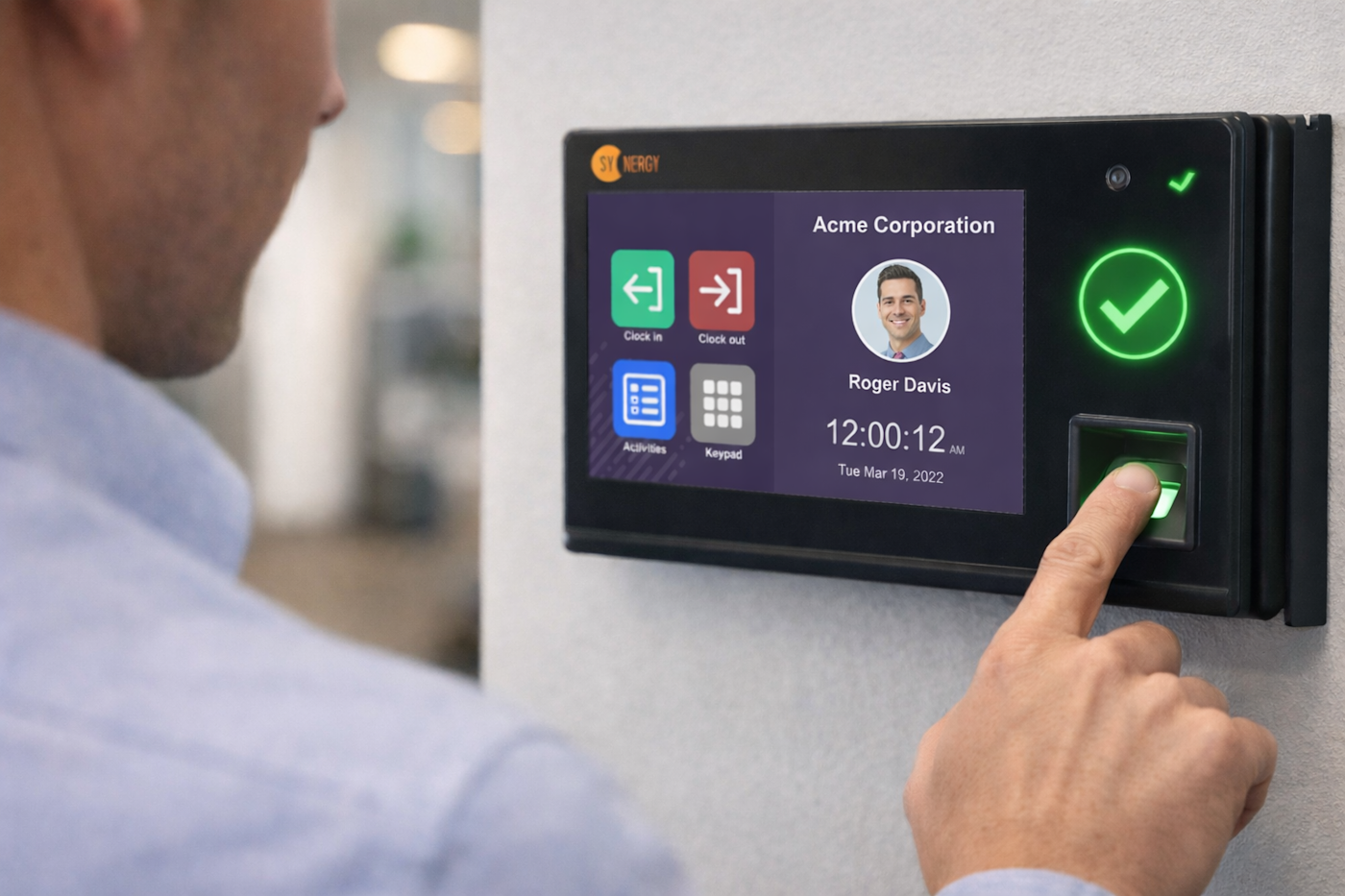
Employee places finger on optical scanner. Device matches against stored template in under 1 second.

3

Record

Time, location, and employee ID logged instantly to Synergy software. Data syncs across all network devices.

Want to calculate your potential savings? Try our ROI Calculator →
UK Installation & Support

Fingerprint Time Clocks Hardware

UK-installed and supported by Synel engineers

Time Clock
Synel
Synergy 5 Fingerprint

Synergy 5 Fingerprint

5" touchscreen biometric terminal with fingerprint recognition for secure time & attendance

FingerprintCard/FobPIN Code
Ideal for:Manufacturing environments, Warehouses and distribution centres, Construction sites
Time Clock
Suprema
Synergy 5 Dual

Synergy 5 Dual

5" touchscreen terminal with both fingerprint and facial recognition for maximum security

Facial RecognitionFingerprintCard/FobPIN Code
Ideal for:High-security facilities, Data centres, Pharmaceutical manufacturing
Time Clock
Suprema
Synergy 10 Fingerprint

Synergy 10 Fingerprint

10" touchscreen biometric terminal with fingerprint recognition for time & attendance

FingerprintCard/FobPIN Code
Ideal for:Large organisations, Manufacturing environments, Warehouses and distribution centres

Need help choosing the right hardware?

Book a Free Site Survey

Built for Your Sector

Manufacturing
Logistics & Warehousing
Construction
Retail
Education
Professional Services

About Fingerprint Time Clocks

Fingerprint biometrics deliver the most reliable form of employee identification. Unlike cards that can be shared or PINs that can be passed around, fingerprints require the employee to be physically present. Our Synergy Fingerprint terminals use high-accuracy optical scanners with 1-second verification, supporting up to 25,000 templates for enterprise-scale deployments.

How It Works

During enrolment, biometric data is captured via USB enroller or directly on the device. The system converts this into an encrypted mathematical template—no actual fingerprint images are stored. When employees clock in, the device compares the live scan against stored templates to verify identity and record the event. Templates sync automatically across all devices on your network.

Eliminate Buddy Punching

The primary driver for fingerprint adoption is preventing time theft. Cards get lent to colleagues, PINs get shared—but fingerprints can't be faked. Every clock event is tied to the actual employee, ensuring you only pay for hours genuinely worked. For organisations losing money to buddy punching, biometric authentication delivers immediate, measurable ROI.

Flexible Authentication Options

Synel devices support multiple identification configurations. Combine fingerprint with card/fob or PIN for multi-factor authentication in high-security environments. Or use fingerprint alone for speed and simplicity. The same biometric data can also control door access via the Synergy Access module—one enrolment, multiple applications.

Built for Demanding Environments

For outdoor or harsh environments, we deploy the Suprema BioEntry W2—an IP67-rated fingerprint reader designed for construction sites, loading bays, and manufacturing floors. Weather-resistant and vandal-proof, it delivers the same fast, accurate verification in conditions where standard devices wouldn't survive.

GDPR Compliant by Design

A common concern is biometric privacy. The reality: Synel devices never store fingerprint images. Biometric data is converted into encrypted mathematical templates that cannot be reverse-engineered. No images are captured during enrolment or verification. This methodology ensures compliance with GDPR and the Data Protection Act 2018.

When to Choose Fingerprint vs Facial Recognition

Fingerprint works best in office environments and where employees have clean, undamaged hands. For manufacturing environments where cuts and abrasions are common, or where touchless hygiene is critical (food production, healthcare), facial recognition may be more suitable. Many organisations deploy both—facial recognition on the factory floor, fingerprint in the offices.

Part of Your Total Solution

Fingerprint data feeds into the broader Synergy ecosystem. Use it for job costing—employees clock onto specific jobs or production lines. Control door access to server rooms or secure areas. In education, the same biometric handles student registration and cashless catering while ensuring anonymity for Free School Meals pupils.
Case Study
Olam Group

8,000+

Employees managed

45

Biometric devices

Olam Group: Biometric T&A for 8,000+ Plantation Workers in Africa

Global agri-business scaled from 1,000 to 8,000+ employees in remote Gabon plantations with biometric T&A.

Discover the full results Olam Group achieved with Synel's solution.

Read the full story

Time & Attendance FAQs

Common questions about time & attendance answered.

How does biometric time tracking work?

Biometric time tracking uses unique physical characteristics such as fingerprints or facial features to identify employees when they clock in or out.

The system captures a template of the biometric data during enrolment, then matches it each time the employee clocks. This eliminates buddy punching and ensures accurate attendance records.

How do I prevent buddy punching?

Buddy punching is where one employee clocks in for another. It is eliminated using biometric authentication.

Synel offers facial recognition and fingerprint terminals that verify the actual identity of the person clocking, not just possession of a card or knowledge of a PIN.

Because biometrics cannot be shared, borrowed or forgotten, you only pay for employees who are physically present. This delivers immediate ROI for organisations experiencing time theft.

Is biometric data GDPR compliant?

Yes, when implemented correctly. Biometric data is classified as special category data under GDPR, requiring explicit consent and a lawful basis for processing.

Synel systems use encrypted templates rather than storing actual fingerprint images or photographs. These templates cannot be reverse-engineered to create an image.

Clear retention policies ensure data is deleted when employees leave, and the system supports the right to erasure.

Do clocking terminals work if the internet goes down?

Yes. Synel's data capture devices feature offline mode. If network connectivity is lost, terminals continue to verify users and store clocking data locally using their built-in memory.

Once connection is restored, data automatically uploads to the central server. No records are lost.

Devices also include battery backup to maintain operation during power outages, typically for up to two hours.

See fingerprint clocking in action

Book a demo to see how Synel can streamline your operations and deliver measurable ROI.

Trusted by industry leaders

Honda Wren Kitchens Fresenius City of London School